The short answer
Yes, if you are the responsible person. Since 1 October 2023, section 156 of the Building Safety Act 2022 requires every responsible person to record the fire risk assessment in full, together with the fire-safety arrangements and any review of the assessment. The old shorthand that written records were only needed with five or more employees is no longer correct.
Who is the responsible person?
In a workplace under an employer's control, the employer — often the company rather than an individual manager — is the responsible person. Depending on ownership and control, an owner, landlord or occupier may also be a responsible person. A facilities manager, building manager or managing agent is not automatically the responsible person; any duty depends on the control they hold and the terms of the arrangement.
Shared premises can have more than one responsible person. They must cooperate, coordinate and record relevant identity, address, responsibility and fire-safety information, keep it updated, and pass relevant information to an incoming responsible person.
The five steps
- Identify the fire hazards.
- Identify people at risk.
- Evaluate, remove or reduce the risks.
- Record the findings, prepare an emergency plan and train people.
- Review and update the assessment regularly.
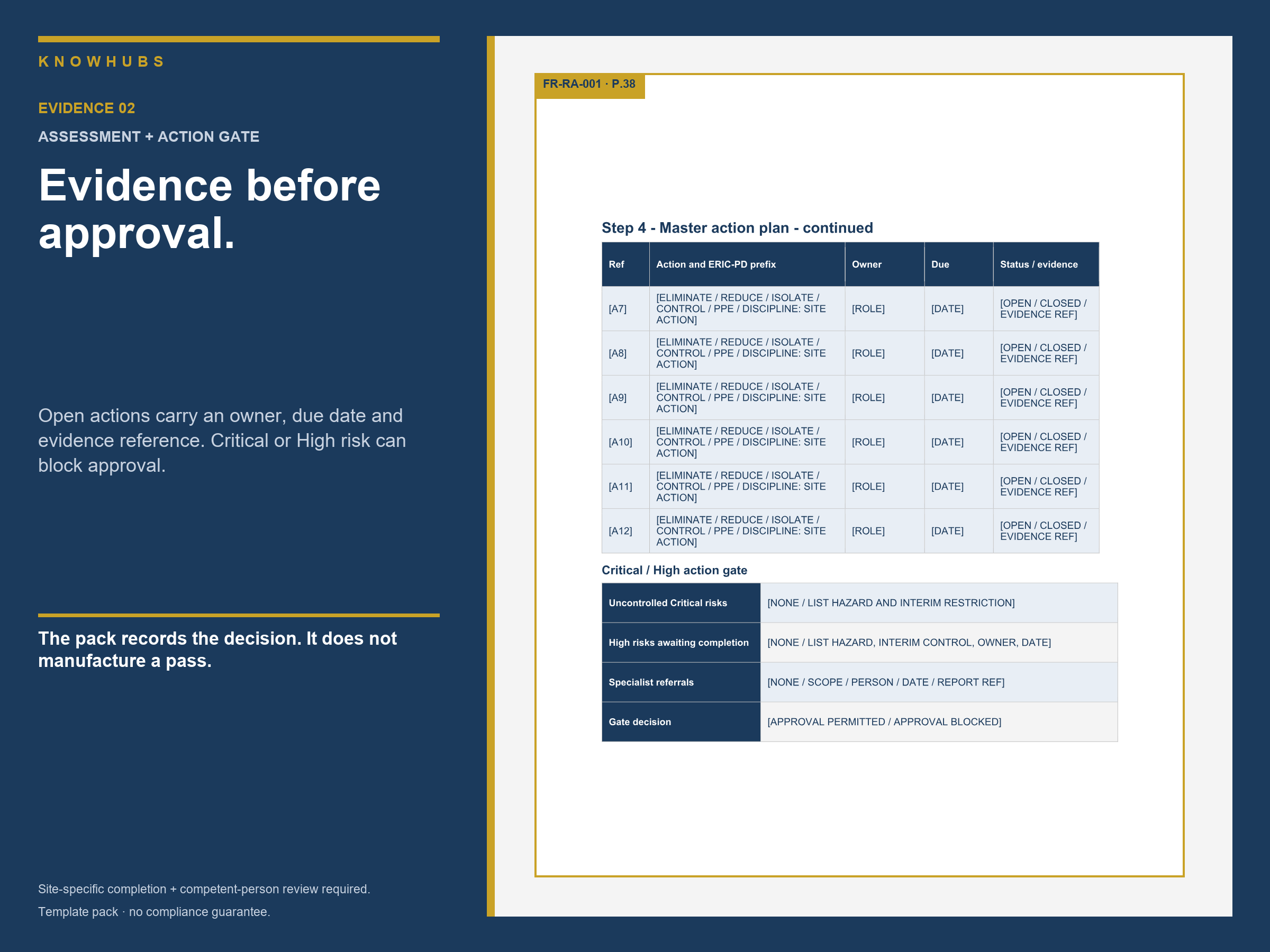
What must the written record cover?
The record must include the full assessment, fire-safety arrangements and any review. It must identify the name and, where applicable, the organisation of anyone engaged to make or review the assessment and, where the legislation requires it, record responsible persons' names, UK addresses and the extent of their responsibilities.
The assessment itself should explain the premises, activities and people; the ignition, fuel and oxygen sources; dangerous substances; escape routes, exits, warning systems, emergency lighting and firefighting measures; people who may be especially at risk; preventive and protective measures; action owners and dates; emergency arrangements; review triggers; and who carried out the assessment.
Consider all relevant persons, including anyone in the immediate vicinity who could be endangered by a fire. Pay particular attention to people who may need extra help: elderly people, young children, sleeping occupants, lone workers, young workers, contractors, visitors, people working out of normal hours, anyone unfamiliar with the building, and people with mobility, sensory or cognitive impairments or who may be unable to evacuate unaided.
Can I do it myself?
A responsible person may assess small, straightforward premises only when they are competent and capable of doing so. If you lack the expertise or time, you need competent help, such as a professional fire risk assessor. The responsible person remains legally responsible for ensuring the assessment is suitable and sufficient.
A well-structured template may help collect evidence and record decisions. It cannot inspect the building, test the precautions or make its user competent.
Seek competent help where the premises, occupancy or fire risks are complex — for example sleeping accommodation, high-risk processes, vulnerable occupants, unusual construction, shared escape routes or uncertainty about the adequacy of existing measures.
Fire Risk Assessment Pack · England and Wales
Five joined-up templates: START-HERE scope guide, evidence-led assessment, display-safe action plan, restricted PEEP record and staff toolbox talk. Supplied as five editable Word masters and five matching PDFs for small, straightforward, low-risk, non-housing premises in England and Wales.
Check the full suitability and exclusion list
View on Etsy · £2.00Watch the 23-second walkthroughOfficial guidance
- GOV.UK — Workplace fire safety: your responsibilities
- GOV.UK — Fire risk assessments
- GOV.UK — Fire safety responsibilities under section 156
- GOV.UK — Means of escape for disabled people
Scope: this guide covers general fire-safety duties for workplaces and small non-domestic business premises in England. It does not cover the additional duties for residential buildings and their common parts under the Fire Safety Act 2021, Fire Safety (England) Regulations 2022 and Fire Safety (Residential Evacuation Plans) (England) Regulations 2025. Scotland and Northern Ireland use different legislation. It is general information, not legal advice or a substitute for a competent assessment of your premises.