
Before you touch the controls
Faster does not always mean escape.
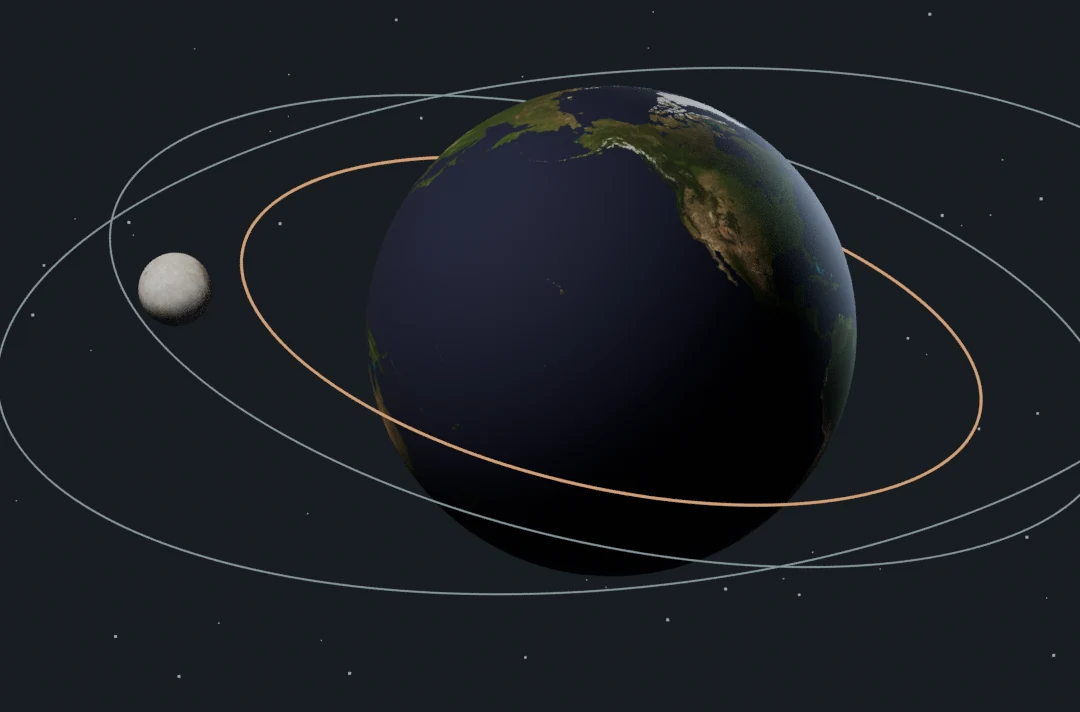
Imagine an object already above a small, isolated world. It starts sideways, with no engine firing afterwards. Gravity pulls inward. Predict what happens if its initial speed increases by a quarter: a larger repeating path, or a one-way departure?
This is a comparison of paths, not a launch simulator. The object begins in space at the same position each time.
Your workbench / One change at a time
Same start. Different sideways speed.
Gravity and starting distance stay fixed. Change the initial sideways speed, then compare the path with the dashed circular reference.
More controls · fine-tune the speed
Use arrow keys or the example buttons. The escape boundary is √2 ≈ 1.414× circular speed at this same starting distance.
Both paths can leave the drawing. Compare these two speeds and check the farthest distance: leaving the screen does not mean leaving the orbit.
At circular speed, gravity changes the direction continuously while distance stays constant. The central body is illustrative; every offered bound path stays outside it.
01 / What bends the path
Moving and falling happen together.
Without a force, the object would carry on in a straight line. Gravity continuously changes its velocity toward the centre. At circular speed, that change bends the motion into a circle.
Choose Slower. The object starts at the farthest point of a smaller ellipse. It gains speed as it falls inward, then loses speed as it rises again. Choose Faster: the start becomes the closest point of a larger ellipse.
02 / What stays bound
Look beyond the edge.
The drawing has a fixed window. A long ellipse can go outside it and still return. The shape’s energy, rather than whether you can see a closed line, separates a repeating orbit from escape.
At a fixed starting distance, escape speed is √2 times circular speed. So 1.25× still returns in this model, while 1.5× escapes. Gravity weakens with distance; it does not disappear at the boundary.
03 / Transfer challenge
Find the almost-escape orbit.
Which offered slider value gives the longest bound orbit: 1.35×, 1.40× or 1.45×? Predict before checking. Then explain why a path can look open in the drawing yet still return.
Reveal the reasoning
1.40× is the largest of those values below √2, so it is still bound. Its farthest distance is 49 times the starting distance, far outside this view. At 1.45× the energy is positive, so the path escapes. “Outside the screen” and “unbound” are different ideas.
Sources & model limits
Checked against NASA’s Newton’s principles, acceleration in orbit and Kepler’s laws, and the archived orbital and escape-speed derivation. No NASA endorsement is implied.
The original diagram uses an analytic two-body Newtonian conic with one fixed central mass, negligible orbiting mass, initial distance 1 and gravity parameter 1. Initial velocity is entirely sideways. Eccentricity = |k² − 1| and specific orbital energy = k²/2 − 1, where k is the speed factor. The drawn body radius is 0.2 starting-distance units. Samples follow angle, not equal elapsed times. The display clips distant sections; the calculated farthest distance remains available.
No atmosphere, thrust, collision response, other bodies, tides or relativity is included. This model is separate from Gravity Foundry’s softened, creative particle field and Solar Atlas’s JPL-based planetary positions. It is not a mission planner or a model of a specific planet.
Keep exploring
From one path to eight worlds.
Explore the actual Solar System in Solar Atlas, or change a creative particle field in Gravity Foundry. Read each model’s limits before comparing the results.